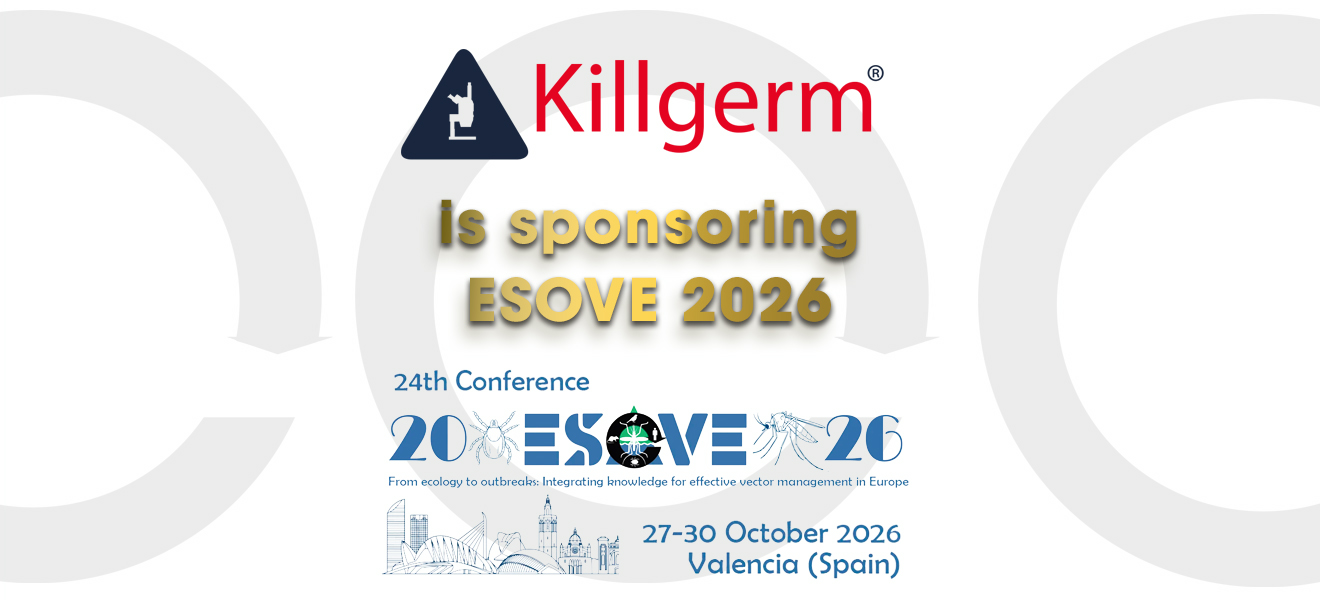
Killgerm Chemicals Ltd and the University of Reading are joining forces at the 24th European Society for Vector Ecology (ESOVE) Conference in Valencia
The ESOVE conference serves as a key international forum uniting professionals, academics, and pest management experts. As highlighted by Dr. Rubén Bueno-Marí (President of the Organizing Committee and European Regional Director of SOVE), the meeting places special emphasis on interdisciplinary collaboration to enhance surveillance systems, early warning strategies, and practical vector management solutions.
Presenting Cutting-Edge Research
Passive Vector Surveillance via Commercial Identification Services
- Authors: Dr. Matthew Davies and Jonathan Binge (Killgerm Chemicals Ltd).
- Focus: Evaluates a five-year dataset (2020–2025) from Killgerm’s Insect Identification Service across 55 invertebrate categories. The study highlights key distribution shifts, including a three-fold surge in clinical cases of the Pharaoh ant (Monomorium pharaonis), an increase in true dipteran vectors (Calliphoridae, Muscidae), and the northern expansion of invasive ants like Lasius neglectus. It demonstrates how commercial passive monitoring networks provide vital intelligence for integrated vector management (IVM).
Rodent Pathogen Identification via Long-Read Sequencing
- Authors: Ana Carolina Yamakawa (University of Reading), Dr. Matthew Davies (Killgerm Chemicals Ltd), and Hyun S. Gweon (University of Reading / UK Centre for Ecology & Hydrology).
- Focus: Compares full-length 16S rRNA and 16S-ITS-23S operon long-read sequencing (using Oxford Nanopore Technologies’ R10.4.1 chemistry) against traditional short-read sequencing in Norway rat droppings. The results show superior species-level resolution, drastically improving public health monitoring and One Health risk management for rodent-borne diseases.
What Else Is on the ESOVE 2026 Programme?
The broader ESOVE 2026 programme offers an extensive lineup of keynotes, turbotalks, and technical sessions tailored to vector biology and control:
- Mosquito Ecology & Invasive Species: Session topics explore population genomics, microhabitat drivers, urban greening impacts, and invasion pathways for species like Aedes albopictus.
- Ticks, Midges, & Sandflies: Presentations cover ecological niche modeling, climate-driven distribution models, host-pathogen dynamics, and tick-borne disease hazards in urban and fragmented landscapes.
- Vector Control Innovations: Discussions centre on AI-assisted decision support, resistance management, and novel control strategies.
- Field Excursions: Attendees will also participate in hands-on rural and urban vector monitoring field activities.
Advancing Public Health Science & Servicing the Industry
For pest control technicians, field biologists, and business owners reading Pest Control News, Killgerm’s active participation in scientific platforms demonstrates how real-world data from the field directly informs industry science.
- A History of Supporting Scientific Platforms: Killgerm has a long-standing history of supporting major international events, including the International Conference on Urban Pests (ICUP) and ESOVE, bridging the gap between academia, public health bodies, and professional pest controllers.
- Elevating Industry Standards: Investing in original research regarding urban vectors and pathogen surveillance ensures that modern integrated pest management strategies evolve alongside emerging public health threats.
- Setting Apart Killgerm’s Technical Advice & Training: This continuous stream of peer-reviewed research directly feeds into Killgerm’s technical support service, field advice, and CPD training courses—ensuring servicing technicians receive guidance grounded in cutting-edge genomic insights and live UK trends.